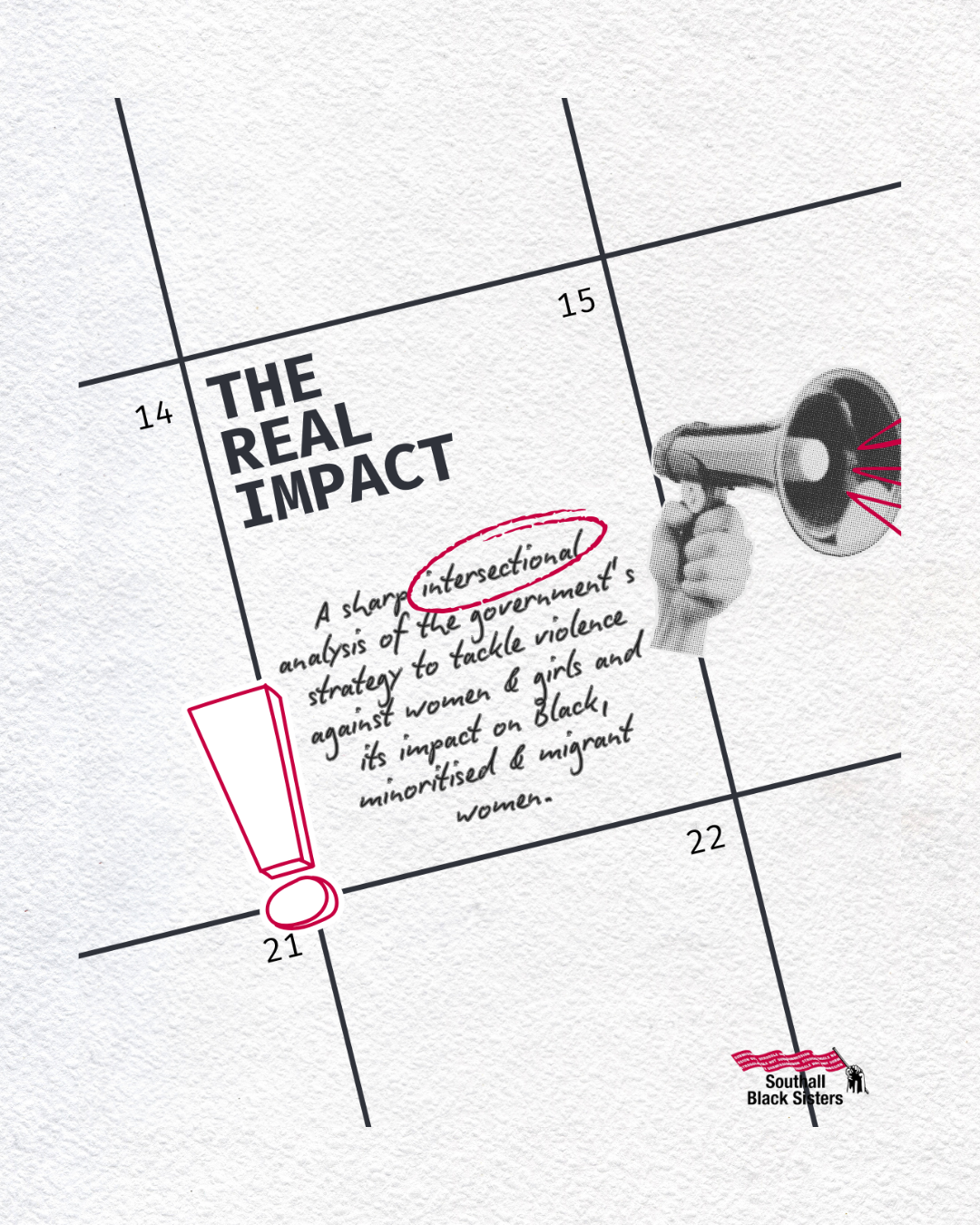



Six months after the publication of the Government’s Freedom from Violence and Abuse: A Cross-Government Strategy to Build a Safer Society for Women and Girls, the gap between political ambition and lived reality remains stark for many Black, minoritised and migrant women.
While the Government has introduced a range of legislative, policing and prevention measures, critical structural barriers – including immigration insecurity, No Recourse to Public Funds (NRPF), and unequal access to specialist support – remain largely unaddressed.
This piece examines what has changed in practice, where progress has been made, and where the Strategy continues to fall short.
A Steady Rollout Across Policing, Legislation and Prevention
The first half of 2026 has seen a significant amount of legislative and operational activity linked to the Government’s violence against women and girls (VAWG) agenda.
On 6 February 2026, Section 138 of the Data (Use and Access) Act 2025 came into force, making it a criminal offence to create or request the creation of AI-generated intimate images without consent, even where the image itself is never produced or shared.
This was followed by royal assent to the Crime and Policing Act 2026 on 29 April 2026, which introduced a number of VAWG-related measures, including strengthened stalking and harassment laws, new tools for managing serial perpetrators, expanded protections relating to AI-generated “deepfakes”, intimate image abuse and a new spiking offence.[1]
The Domestic Abuse Protection Order (DAPO) pilot has also continued to expand. Initially launched in November 2024 across Greater Manchester and three South London boroughs, the pilot has since extended into the North-East and North Wales. DAPOs allow courts to impose curfews, exclusion zones and electronic monitoring on perpetrators, with breaches carrying a sentence of up to five years’ imprisonment.[2]
Alongside this, the Government has continued to invest heavily in policing-led responses. Raneem’s Law – embedding domestic abuse specialists directly into 999 control rooms – launched in February 2025 across five pilot forces: West Midlands, Northumbria, Northamptonshire, Bedfordshire and Humberside. Backed by £2.2 million investment, the scheme is expected to be rolled out nationally across all 43 police forces in England and Wales.
Additional investment has also been announced for a new National Centre for VAWG and Public Protection, backed by £13.1 million in funding, alongside £1.5 million to expand Rapid Video Response (RVR) schemes enabling victim-survivors to engage with police remotely via secure video calls.[3]
The concentration of investment in policing and perpetrator management continues to raise wider questions about whether the Strategy priorities enforcement responses over the structural conditions that enable women to achieve long-term safety and stability.
Alongside policing measures, the Government has continued to emphasis its wider commitment to victim-survivor support, backed by the headline pledge of more than £1 billion linked to the VAWG Strategy.
This includes £160 million for safe accommodation provision through local authorities in 2025/26, expansion of the Child House model for child victim-survivors, and the introduction of new NHS safeguarding learning programmes and GP referral pathways. The Crown Prosecution Service (CPS) has also begun piloting enhanced support for high-risk domestic abuse victim-survivors, while a new Youth Support Helpline aimed at addressing harmful behaviours in early intimate relationships among young people is expected to launch later this year.
A “Partial Firewall”, But Not a True One
After years of campaigning, led by Latin American Women’s Rights Service (LAWRS), Southall Black Sisters (SBS), and the Step-Up Migrant Women coalition, the Strategy acknowledges for the first time that migrant women’s fear of immigration enforcement acts as a barrier to reporting abuse.
Negotiations with the Home Office led to the introduction of a requirement for the police to obtain informed consent from victim-survivors before sharing their data with Immigration Enforcement – a significant development given that information-sharing has historically taken place without consent.[4]
This represents real progress. But as SBS and others have repeatedly stated, consent-based data-sharing is not a firewall.
It transfers the burden of risk and decision-making onto the victim-survivor, particularly those who do not speak English as a first language, while offering no automatic protection from immigration enforcement, destitution, homelessness or NRPF following disclosure.
A true firewall would prevent data-sharing between the police and Immigration Enforcement altogether, except in narrowly defined exceptional circumstances.
Political Change and Accountability
These developments have taken place against a backdrop of considerable political instability and ministerial change.
In May 2026, four junior ministers resigned in quick succession, including Jess Phillips, the Minister for Safeguarding, and Alex Davies-Jones, Minister for Victims – two of the most prominent figures associated with the Government’s VAWG agenda. Their departures came just months after the publication of the Strategy and at a critical stage in its early implementation.
Phillips has since been replaced by Natalie Fleet as Safeguarding Minister, while Catherine Atkinson has taken over the Victims portfolio. Baroness Harriet Harman was also appointed as the Prime Minister’s Adviser on Women and Girls with a remit covering VAWG, economic opportunity and representation.[5]
While changes in ministerial leadership are not unusual, the scale and timing of these shifts raise wider questions about continuity, accountability and the Government’s long-term political commitment to deliver meaningful change.
Sustained progress on VAWG will depend not only on policy announcements, but on whether those commitments are backed by long-term investment and structural reform.
Our Analysis
The Strategy’s tone marks a genuine departure from how VAWG has historically been framed within government policy. Coercive control, misogyny and institutional failure are named more directly, and the recognition of immigration-related barriers facing migrant victim-survivors is long overdue.
But ambition is not the same as protection.
For the women SBS supports every day, the Strategy continues to fall short in critical areas. Prevention remains heavily framed through policing-led and intelligence-led perpetrator management approaches that mirror serious crime and counter-terror frameworks, carrying real risks of surveillance, racialised policing and misidentification within Black, minoritised and migrant communities.
There also remains limited clarity around long-term, ring-fenced funding for specialist ‘by and for’ services, despite continued evidence that these organisations are central to supporting Black, minoritised and migrant victim-survivors.
At the same time, there is still very limited focus on structural prevention measures such as immigration security, access to public funds, safe housing and welfare support. The most marginalised women – including undocumented women, women outside the spousal/partner visa route, and women with NRPF continue to be left without automatic protection.
These concerns are unfolding within a wider political climate in which migration, criminal justice and public protection are increasingly framed through securitised and racialised narratives. Across political and public debate, VAWG is increasingly being co-opted to justify harsher immigration controls, punitive policing measures and exclusionary notions of safety, with significant implications for Black, minoritised and migrant communities.
Without structural reform, the Strategy risks improving access to reporting for some victim-survivors while continuing to leave thousands of others trapped in abuse, danger and precarity.
Conclusion
We welcome the legislative and operational developments introduced over the past six months, as well as the growing recognition of the barriers facing migrant victim-survivors.
But the real test of any VAWG Strategy is whether the women most exposed to harm are actually able to access safety, protection and support in practice.
On that test, the Strategy continues to fall short for many Black, minoritised and migrant women. Without structural reform, immigration security and sustained investment in specialist support, the gap between policy ambition and lived reality will remain.